
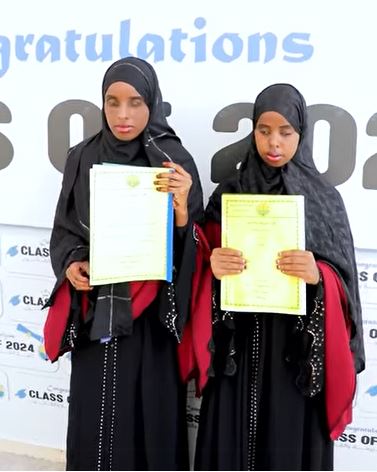
Nafisa Ahmed and Ifrah Ahmed are undergraduate students with visual impairments from Mogadishu University, Faculty of Law and Sharia. Despite their disabilities, they have shown strong determination and resilience in pursuing their academic and professional goals.
Over the past two years, they have actively pursued public opportunities through disability inclusion programs. During this period, they faced discrimination in many areas due to their visual impairments, which created significant barriers to equal participation and access to opportunities.
Despite these challenges, support from partner organizations has played an important role in their progress. SDN supported one of the students through an internship and training program, which helped build professional skills and confidence.
During her internship period, she made valuable contributions to disability rights advocacy, focusing on promoting inclusion, empowerment, and equal opportunities for persons with disabilities. She was particularly active in advocating for the rights of women and girls with disabilities.
Their journey reflects the importance of inclusive programs and institutional support in empowering young women with disabilities. Nafisa Ahmed and Ifrah Ahmed continue to serve as inspiring examples of resilience, advocacy, and leadership among youth with disabilities in Somalia.
The two sisters were orphaned at a young age after losing their mother and were raised by their father, who took on the responsibilities of both parents. He played a crucial role in supporting his visually impaired daughters, ensuring they received care, protection, and access to education despite significant challenges.
In Somalia, access to education is extremely difficult for many children and youth, even those without disabilities. Nevertheless, their father believed strongly in the future of his daughters and invested everything he could in their education, determined that disability would not define their limits or their potential.
However, the question of disability discrimination still stands before the family. Both public and private sectors continue to present barriers for persons with disabilities, limiting their access to employment, inclusion, and equal opportunities.
Ifrah, who is now married and a mother of two children, has faced serious challenges in securing employment within public institutions. Her attempts ended in exclusion and rejection, with her skills, education, and values being overlooked due to her disability.
Disability remains a major social issue within Somali culture, where negative beliefs persist. Many people view disability as a curse or bad luck, leading to stigma, discrimination, and marginalization of persons with disabilities, especially women and girls.
