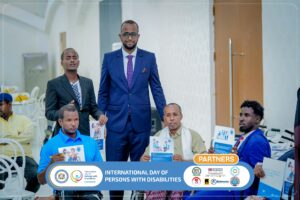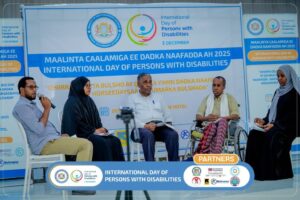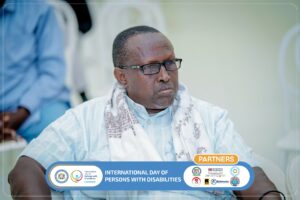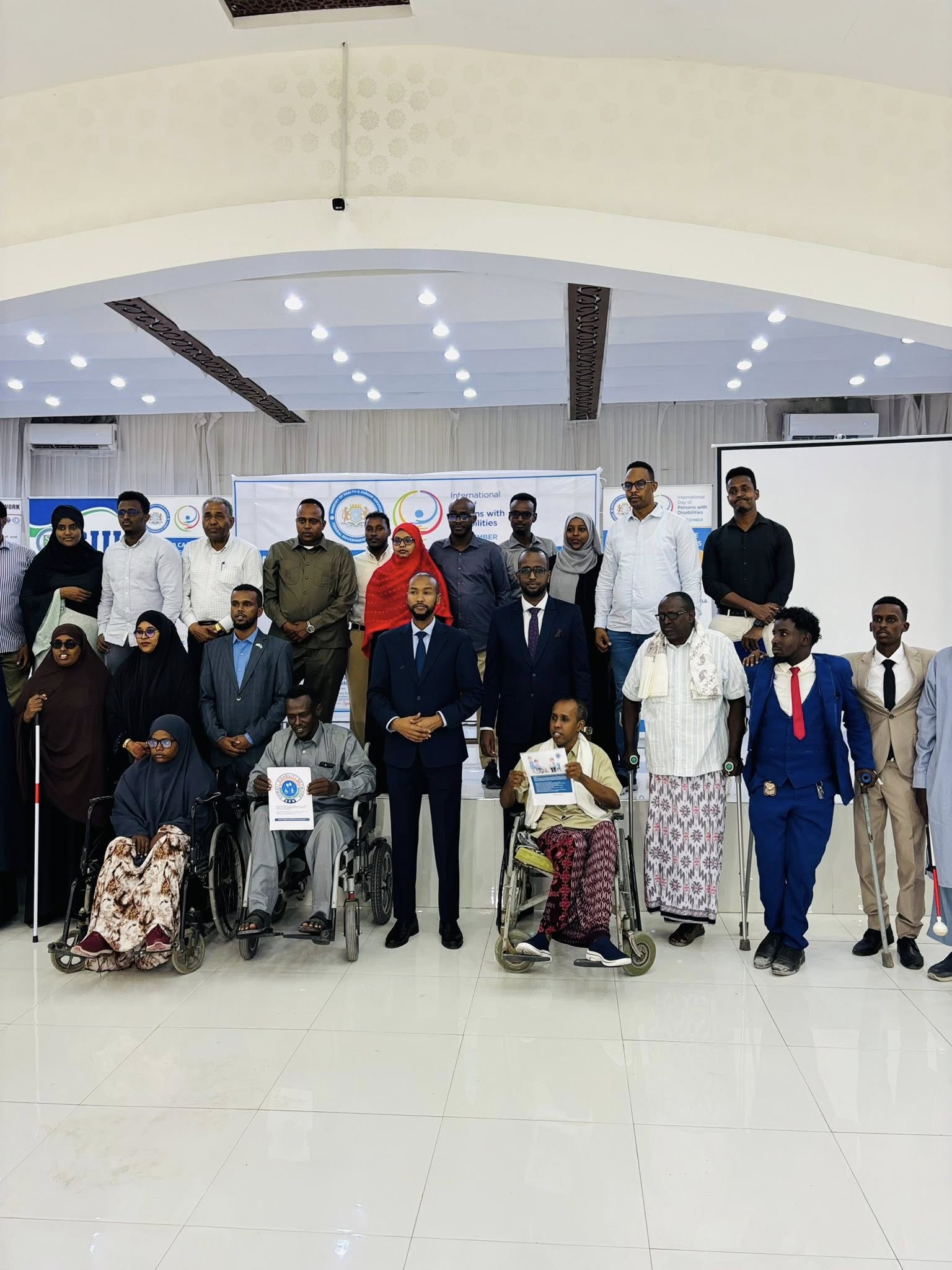
The International Day of Persons with Disabilities was celebrated on 3 December 2025 in Somalia through a collaborative event organized by the Somalia Federal Government Ministry of Health and the Somali Disability Network. The event brought together government representatives, civil society organizations, international partners, private sector institutions, universities, and hospitals to highlight progress and challenges disability inclusion in health, education, and employment in somalia.
Globally, there are approximately 1.3 billion persons with disabilities (PWDs), and in Somalia, PWDs make up about 16% of the 19 million population, totaling roughly 3 million individuals. Where children and youth comprise 75% of PWDs, meaning over 2.2 million young people live with disabilities. This proportion is significantly higher than in the general population, underscoring the urgent need for targeted interventions, inclusive education, healthcare, and social support systems to ensure that Somali children and youth with disabilities can access opportunities and fully participate in society.
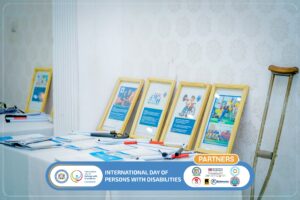
Members from the Somali Disability Network (SDN), a coalition of 16 organizations, presented their achievements and contributions toward advancing disability inclusion. Their work includes producing books, reports, awareness guidelines, and manuals, as well as providing essential mobility aids such as wheelchairs, crutches, white canes, and orthopedic support materials for children. In addition, they supplied recreational and educational game tools designed to support children with disabilities, promoting both learning and social inclusion.
Key speakers
Dr. Mohamed Hassan Mohamed Bulaale, Minister of Health Care and Human Development, emphasized that persons with disabilities (PWDs) are a national priority, not just a matter of government statements. He reaffirmed the commitment of the President and Prime Minister of Somalia to giving higher priority to PWDs and announced the establishment of a dedicated disability inclusion unit within the Ministry of Health.
The Minister pledged the inclusion of PWDs across different departments of the Ministry, the development of accessible facilities, and the full implementation of disability-inclusive policies and legislation. He stressed that meaningful inclusion must be led by PWDs and Organizations of Persons with Disabilities (OPDs), with government and international partners playing a supportive role.
Professor Suheyb Ilmi Dhuhulow, Deputy Administrator of Somalia International University, highlighted the potential and talents of PWDs in education. He announced that every student with a disability who graduates from secondary school and passes the national government examination will be offered a full scholarship at Somalia International University.
Mr. Mohamud, a student and member of the PWD community at SIU, emphasized that PWDs possess hidden talents and abilities that can be realized through access to education and fair employment. He explained that disability is not inability, and discrimination in society is often the main barrier preventing PWDs from fully participating in social and economic life.
Ms. Hodan Said, a PWD student, highlighted the challenges faced by PWDs seeking higher education and employment. She explained that in the past, PWDs were confined to roles such as guides or home workers and often kept indoors. She emphasized that PWDs need support that empowers them, rather than returning them to isolation or neglect. She also drew attention to the double challenges faced by women and girls with disabilities and moved the audience with a powerful song performed at the event.
Dr. Faisal Mohamed Kasim, representing Bahnano Physiotherapy Center, shared that his center provides modern physiotherapy services to hundreds of people every month, including children, adults, and the elderly with cerebral palsy and other disabilities. Services are provided free of charge to PWDs, while also supporting non-disabled individuals with physical injuries or stress. He reaffirmed the center’s commitment to supporting PWDs and renewing their pledges made at last year’s event.
Ms. Ayan Said, representing civil society organizations, highlighted the persistent challenges PWDs face in public and private institutions. She called for stronger policies, better accessibility, and increased opportunities for inclusion in education, employment, and health. The event concluded with a collective call for sustained collaboration between government, OPDs, civil society, universities, and international partners to ensure that persons with disabilities in Somalia can live with dignity, access opportunities, and participate fully in all aspects of society.
Panel Discussion
The panel on disability inclusion featured four panelists: a Pediatric Doctor, a Health Advisor, a Member of PWDs, and a Human Rights Activist. They discussed the situation of PWDs in Somalia, progress and challenges in social, policy, and development programs, and strategies to enhance disability inclusion. Each panelist shared insights from their experience, highlighting achievements and remaining barriers to full participation for PWDs.
Progress in Disability Inclusion in Somalia
Somalia has made notable strides in promoting disability inclusion. Persons with disabilities (PWDs) are increasingly accessing education, vocational training, and employment opportunities, which has strengthened self-reliance and social participation. Organizations of Persons with Disabilities (OPDs) have grown stronger, forming unions, coalitions, and advocacy networks that influence national policies and participate actively in disability programs. The government has passed disability-related laws and established the National Disability Agency, institutionalizing disability governance and improving coordination. In addition, the creation of Paralympic teams and organization of sports events have provided platforms for PWDs to showcase their talents, challenge stereotypes, and promote community engagement. Nationwide advocacy campaigns and participation in international processes have amplified the voices of PWDs and increased public awareness on disability inclusion.
Challenges of Disability Inclusion in Somalia
Somalia still face widespread exclusion and barriers in education, health care, employment, and humanitarian assistance. Physical infrastructure, public services, and communication systems are largely inaccessible, limiting opportunities for meaningful participation. Legal frameworks such as the UN CRPD and the National Disability Act are not fully implemented, and the National Disability Agency provides limited support. Many PWDs, especially those in IDP camps, experience poor living conditions, forced evictions, and lack of access to rehabilitation, medical care, and assistive devices. Exclusion from national programs, recruitment discrimination, limited funding for Paralympic sports, and inadequate emergency response mechanisms further hinder the inclusion and empowerment of PWDs across Somalia.
The Recommendations of the Event :
Recommendations to Persons with Disabilities (PWDs)
PWDs should participate in community decision-making, pursue education and skills, join OPDs, and engage in awareness campaigns to advocate for their rights, enhance independence, and challenge social stigma.
Recommendations to Civil Society Organizations (CSOs)
CSOs should mainstream disability inclusion in all programs, allocate budgets for accessibility, recruit PWDs, partner with OPDs, and document lessons to strengthen learning and accountability.
Recommendations to Organizations of Persons with Disabilities (OPDs)
OPDs should build leadership and management capacity, work in coalitions, monitor government commitments, engage in policy advocacy, and collect data to support national and international disability initiatives.
Recommendations to International NGOs (INGOs)
INGOs should involve PWDs and OPDs in all project stages, fund OPDs for long-term development, recruit PWDs in leadership roles, and align interventions with the UN CRPD and Somalia’s disability laws for sustainable impact.