
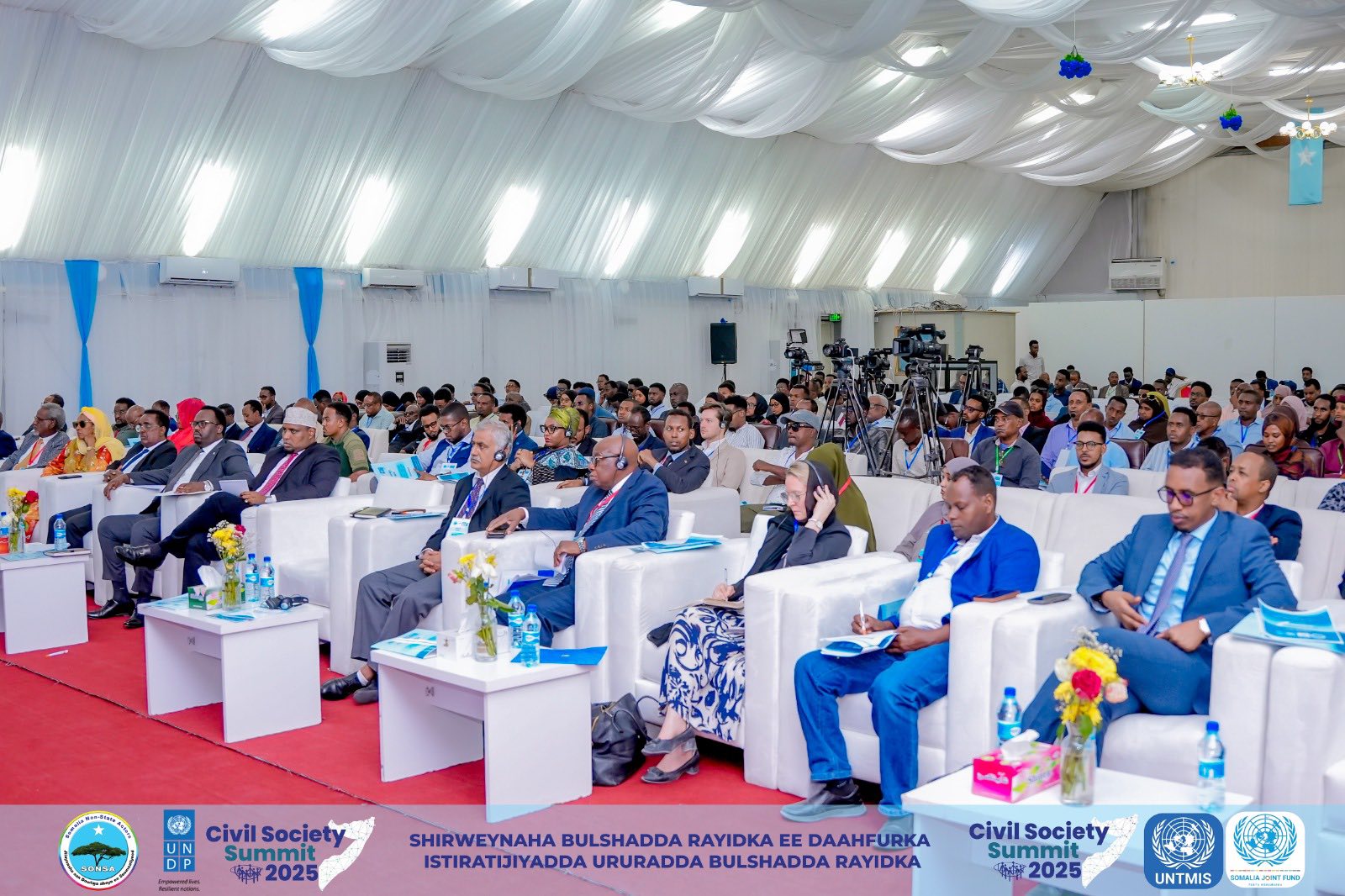
The three-days Somalia Civil Society Summit 2025 officially opened on Monday, December 8, 2025, in Mogadishu. The high-level gathering, organized by SONSA – Somalia Non-State Actors, the largest civil society consortium in the country – brought together representatives from national and international institutions. The summit commenced with the recitation of the Holy Quran, followed by opening remarks highlighting the objective of strengthening coordination, engagement, and policy dialogue between civil society and state actors.
During the opening session, the Director of SONSA emphasized the importance of connection and cooperation among stakeholders throughout the summit. He reaffirmed the role of the summit in creating a collective platform for policy advancement, accountability, and sustainable development, noting that Somalia’s development journey requires unified voices and shared responsibility.
Mr. Osman Tahliil, Chairperson of SONSA delivered a historical reflection on Somalia’s civil society journey. He explained that civil society organizations emerged after the government collapsed in 1991, stepping into a critical gap when public and private service delivery had come to a halt. CSOs led lifesaving humanitarian programs during droughts, famines, and civil wars, and contributed to early peacebuilding and reconciliation efforts in Embagati (Kenya) and Arta (Djibouti). “Today,” he stated, “we stand as key stakeholders in state-building, and we extend our gratitude to international donors present here for being valuable partners in Somalia’s progress.”
Mr. Abdinasir Burale, Director of the Puntland Development Research Center (PDRC), emphasized that nation-building requires resilience, accountability, long-term vision, and integrity. He noted that the transparency of civil society, peacebuilding efforts, and reconciliation initiatives carried out by Somali civil society remain immeasurable and invaluable. He praised the Somali civil society organizations for their continued role and unwavering dedication to the development and progress of the nation.
Mrs. Duniya Mohamed Ali, a member of Somali women activists, stated that when the country collapsed, the first to stand up were the women, and they were rightfully recognized for their sacrifice—proving that women are the backbone of society. Speaking on behalf of Somali women, she affirmed the demand for the 30% women quota and emphasized the need for transparent and credible elections. She noted that the strength of civil society has largely been carried by women, who invested their time, resources, and lives when men were driven into political and clan conflicts.
Mr. Abdullahi Hassan, the Chairperson of the Somalia Disability Network—a coalition of 15 OPDs, special schools, and IDP camp–based organizations serving persons with disabilities—expressed his gratitude to the participants and organizers by name and title. He emphasized that the participation of disability representatives in this high-level three-day consultation is a significant step toward establishing a five-year National CSOs Strategy that truly reflects disability inclusion. He highlighted that persons with disabilities in Somalia represent between 16% and 20% of the population nearly three million people who for decades have been excluded from rights, services, and decision-making. Although CRPD was ratified in 2019 and a National Disability Act was passed in 2024 mandating a 5% quota for employment and political participation, implementation remains insufficient. He stated, “We demand meaningful disability inclusion across all sectors—education, health, employment, partnership, and humanitarian assistance—so that persons with disabilities are recognized as equal citizens of Somalia.”
Mr. Raisedon Zenenga, Deputy Country Representative of the United Nations Transitional Assistance Mission in Somalia, expressed his appreciation for the Somalia CSOs Summit 2025, describing it as a sign of hope and progress for the nation. He emphasized that civil society organizations are key actors that fill critical gaps and support communities through essential services. Mr. Zenenga encouraged Chairman Osman and the SONSA team to continue their valuable work, noting that CSOs play an important role in holding government accountable, facilitating peaceful elections, supporting reconciliation, restoring public services, and giving hope and life to civilians. He commended the unity and commitment of CSOs in supporting the country’s transition from years of conflict toward democratic elections.
Hon. Mahamud Abdirahman Sheikh Farah (Beene-Beene). the Ministry of Planning, Investment, and Economic Development of Somalia “We recognize and highly commend the essential role that SONSA plays in strengthening civil society across Somalia. On behalf of the Ministry of Planning, Investment, and Economic Development of Somalia, I warmly welcome this summit and reaffirm our firm commitment to continue supporting, empowering, and advancing all actors engaged in humanitarian work, social development, and community cohesion,” said Hon. Mahamud Abdirahman Sheikh Farah (Beene-Beene). He praised the consistent engagement of civil society leaders, including disability representatives, who participate in national consultations and contribute to planning and implementation efforts. He emphasized that Somalia can reach greater heights through unity and collaboration, calling on donors to invest in Somali-led initiatives, particularly those focused on youth and women, as they are the driving force capable of shaping the country’s future development and politics.
Hon. Ali Yusuf Hoosh, Minister of Interior and Reconciliation, expressed his appreciation for SONSA’s leadership in organizing the summit and for their significant contribution to national development. He stated that the government remains committed to supporting their efforts and strengthening cooperation with civil society. The Minister emphasized the importance of moving toward a different and more credible electoral process than in previous years, highlighting the goal of achieving a system based on “one person, one vote” that reflects fairness, trust, and the will of the Somali people.
Hon. Salah Ahmed Jama, Prime Minister of the Federal Government of Somalia . officially opened the Civil Society Summit for the Launch of the National Strategy. In his remarks, he expressed admiration at the large presence of young leaders, calling it a victory for civil society and a sign of generational transition. “I myself emerged from civil society, and I believe this new generation will replace the old and lead the future,” he stated. The Prime Minister acknowledged the historic role of Somali civil society in nation-building, noting that civil society leaders were instrumental in stopping conflicts, preventing further bloodshed, and consistently promoting peace. He further emphasized that during difficult periods of national crisis, civil society stood firmly beside the people, demonstrating resilience and unwavering commitment to peace, stability, and public service—efforts from which the country continues to benefit today.
“Look at persons with disabilities they stand up for their rights, and I only made compromise to ease their suffering when support for vulnerable people was lacking.” “To the international community and partners here today we have made progress together; the country is rising from the ashes, the people are advancing, and civil society remains the guiding force supporting the government’s journey forward.”
Mr. Mohamed Abdullah, General Manager of the Horn Center in Dhusamareb, highlighted the challenges and progress in the Galmudug State. After years marked by wars and armed conflicts, the region has faced repeated humanitarian crises, including droughts, floods, and other disasters. Despite these hardships, efforts in development have advanced, focusing on infrastructure and essential services. Mr. Abdullah emphasized that peace remains central, noting that addressing past wars and conflicts is crucial to sustaining long-term stability and progress in the state.
Sara Farah Godane from JB CSOs emphasized that civil society organizations work to serve the people and promote peace and coexistence, which remain rare in Somalia. Each CSO has committees for different sectors and is involved in policy advocacy. He noted that rural areas face risks of tribalism and conflict, highlighting the need for awareness and advocacy. In JB and Kismayo, where hundreds of clans live, CSOs have successfully fostered peace and coexistence instead of tribal conflict. Thanks to government support, civilians in JB do not carry weapons. Research conducted by CSOs shows that women and girls play a significant role in both war and peace processes. He encouraged all Somali citizens, especially in JB, to support peace and stability, emphasizing that the government is the strongest institution over all.
Finally, the senior consultant presented on the work, role, and strategic direction of Somali CSOs. The presentation covered objectives, planned activities, key stakeholders, and thematic interventions, including support for women, youth, IDPs, and persons with disabilities. He outlined guidelines, progress tracking, monitoring and evaluation, and risk management for the five-year CSO strategic plan, aligning it with Somalia’s National Development Plan 9 (NDP9) and National Transitional Plan 10 (NTP10). The consultant also highlighted the critical role of CSOs across sectors in supporting development, governance, and humanitarian efforts throughout the country.
